
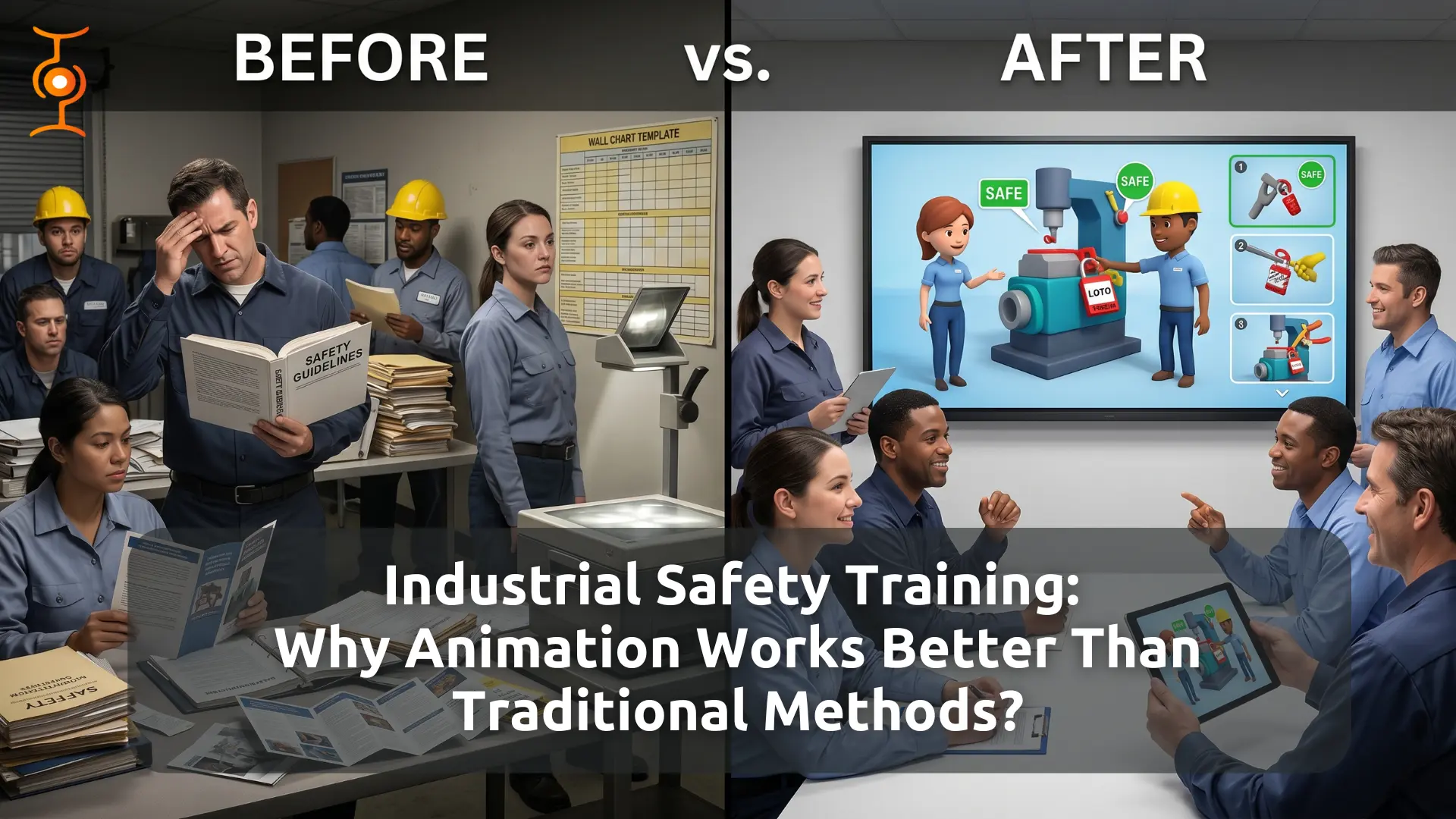
If you've ever sat through a 3-hour classroom safety induction with dense PowerPoint slides and a monotone instructor, you already know the problem. Workers tune out. Retention plummets. And when a real hazard appears on the floor, the training simply doesn't surface in time.
That's why forward-thinking EHS (Environment, Health & Safety) managers are switching to safety training animated videos — and the numbers are hard to argue with.
The Retention Crisis in Industrial Safety Training
Traditional safety training has a measurable retention problem. According to research by the National Training Laboratories, lecture-based learning yields an average retention rate of just 5%, while audiovisual learning improves that to 20%. But interactive animated simulations? They push retention rates as high as 75%.
In industries where a missed safety step can mean a lost finger, a chemical burn, or a fatality, that gap isn't academic — it's the difference between a safe workplace and an OSHA recordable incident.
The U.S. Bureau of Labor Statistics reported 2.6 million non-fatal workplace injuries in a single recent year, with a significant portion traced back to inadequate or poorly retained safety training. The cost? The National Safety Council estimates the average workplace injury costs employers $42,000 — and a fatality averages over $1.2 million in direct and indirect costs.
What Makes Safety Training Animated Videos So Effective?
1. Visualization of Invisible Hazards
Many industrial hazards are invisible to the naked eye — toxic gas leaks, electrical arc flash zones, radiation fields, or confined space oxygen depletion. Animated safety training videos for hazardous environments can render these dangers visually, giving workers a visceral understanding they simply can't get from a text checklist.
A well-produced animation can show exactly what happens inside a boiler when pressure builds beyond the safety valve threshold — something no live demonstration could safely replicate.
2. Consistent Delivery Every Single Time
A human trainer has good days and bad days. They skip sections when running late. They emphasize topics based on personal bias. An animated EHS training video delivers the same accurate, compliant message to every worker — whether it's the first employee or the five-hundredth, on day shift or night shift.
This consistency is critical for OSHA compliance training animated content, where regulatory accuracy is non-negotiable.
3. Engagement That Drives Completion Rates
Studies by Forrester Research found that employees are 75% more likely to watch a video than read a document of the same length. In the context of mandatory workplace safety e-learning modules, this means higher completion rates, fewer compliance gaps, and better audit outcomes.
Animation takes this further. A well-crafted animated scenario — say, a worker failing to lock out a machine and the consequences unfolding — creates emotional engagement that text cannot. That emotional anchoring is precisely what makes information stick.
4. Language and Literacy Barriers Eliminated
Manufacturing and construction workforces are often multilingual. Multilingual animated safety training videos solve a problem that traditional instructor-led training can't: they can be dubbed or subtitled in any language without re-hiring trainers or re-shooting content. One study found that non-English-speaking workers are 30% more likely to be involved in workplace accidents — a gap that localized animated content directly addresses.
5. Scalability and Cost Efficiency
A one-time investment in a 3D animated industrial safety training video can be deployed to thousands of workers across multiple sites indefinitely. Compare this to instructor-led training, which requires scheduling, travel, venue costs, and repeated hourly fees. Companies report 40–60% reductions in per-employee training costs after transitioning to animated video-based programs.
Animation vs. Traditional Methods: A Direct Comparison
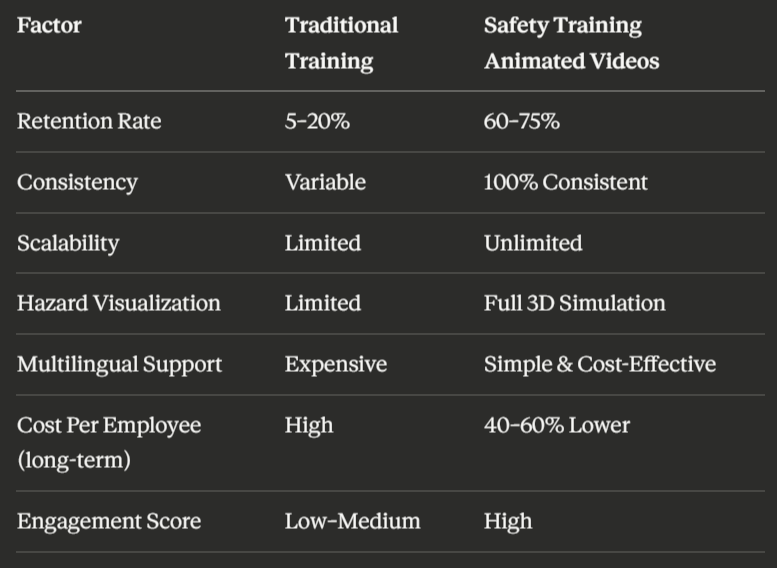
Factor Traditional Training Safety Training Animated Videos Retention Rate 5–20% 60–75% Consistency Variable 100% Consistent Scalability Limited Unlimited Hazard Visualization Limited Full 3D Simulation Multilingual Support Expensive Simple & Cost-Effective Cost Per Employee (long-term) High 40–60% Lower Engagement Score Low–Medium High
Real-World Industries Winning With Animated Safety Training
Oil & Gas: Animated permit-to-work training videos explain complex lockout/tagout and hot work permit processes in under 4 minutes — replacing 8-hour classroom sessions.Construction: Animated fall protection training videos have helped sites reduce fall-related incidents by up to 35% after implementation.
Chemical Manufacturing: Facilities using animated PPE training videos report a 28% improvement in correct PPE usage observed during audits.
Mining: Underground hazard simulations via animation reduced near-miss incidents by 22% at several mid-size operations.
How to Choose the Right Animated Safety Training Video Partner?
When evaluating vendors for custom animated workplace safety videos, look for:
Regulatory alignment — Does the content reflect current OSHA, ISO 45001, or industry-specific standards?
Customization depth — Can they replicate your actual facility, equipment, and workflows?
LMS compatibility — Will the videos integrate with your existing Learning Management System as SCORM-compliant modules?
Multilingual capability — Can they deliver dubbed or subtitled versions efficiently?
Microlearning format — Are modules broken into 3–5 minute segments for maximum engagement?
FAQs:
Q1: Are animated safety training videos OSHA compliant?
Yes, animated safety training videos can be fully OSHA compliant as long as the content accurately reflects current regulatory standards. Many organizations use them as the primary delivery method for OSHA 10 and OSHA 30 training content.
Q2: How long should a safety training animated video be?
Research supports microlearning formats of 3 to 7 minutes per module. Longer topics should be broken into a series of short segments rather than one extended video to maintain engagement and improve retention.
Q3: Can animated safety videos replace in-person safety training entirely?
For many topics — including hazard identification, equipment operation procedures, and emergency response — animated videos can fully replace classroom sessions. However, hands-on skills like fire extinguisher use or CPR still require practical components alongside digital training.
Q4: What is the cost of producing a safety training animated video?
Production costs vary widely. A basic 2D animated safety module typically ranges from $3,000 to $8,000, while a detailed 3D animated industrial training video with custom environments can range from $10,000 to $30,000+. The ROI is typically realized within the first training cycle for organizations with 200+ employees.
Q5: What industries benefit most from animated safety training videos?
Oil and gas, construction, chemical manufacturing, mining, utilities, food processing, and heavy manufacturing see the greatest impact — industries where hazards are complex, high-stakes, and difficult to replicate in a live training environment.
Chasing Illusions Studio
Premium animation & video production studio based in Delhi, India. Specialising in 3D animation, medical visualisation, architectural walkthroughs, and CGI.